The Fourth Amendment and The Truman Show
Dillon Woods
Please note: I use ChatGPT as an editing and drafting tool under my direction to improve clarity and flow of my writing. Immediately after using ChatGPT for this project and submitting it to the Supreme Court, the CIA Checchi family attacked the home of OpenAI/ChatGPT CEO, Sam Altman—first they sent a man who tried to set his house on fire, and then they sent a gunman who shot at the house. The CIA Checchi family is furious that I am having so much success using ChatGPT in my case against them at the Supreme Court, and they are demanding that the company allow them access to ChatGPT so that they can manipulate the answers I receive when I use it for my case against them. The corruption and abuse of power coming from this one CIA family is more than shocking, it’s a level of misconduct that demands immediate scrutiny and accountability.
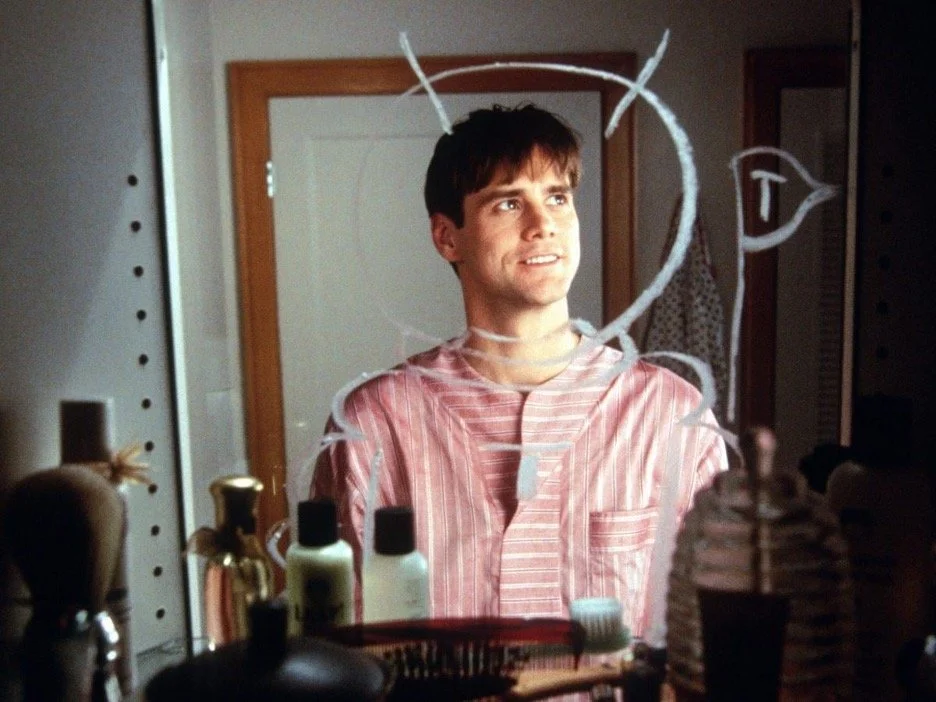
The Truman Show is one of those rare films that works on multiple levels at once—psychological, philosophical, technological, and even prophetic. Directed by Peter Weir and starring Jim Carrey, it presents a deceptively simple premise: a man unknowingly lives his entire life inside a fabricated reality television set, broadcast to the world 24/7. But beneath that premise is a layered critique of control, perception, and freedom. It is a fact that the lives of many Americans have come to resemble the life of Truman Burbank in this film.
At its core, the movie is about the nature of reality and illusion. Truman Burbank’s world, Seahaven, is artificially constructed yet indistinguishable from reality to him. This mirrors philosophical ideas like Plato’s “Allegory of the Cave,” where individuals mistake shadows for truth because that is all they have ever known. Truman’s gradual awakening—his noticing inconsistencies, repeated patterns, and staged interactions—represents the human instinct to question reality when something feels “off.” The film suggests that truth is not always given; it must be pursued, often at great personal cost.
Another major theme is control versus free will. Truman’s life is meticulously orchestrated by the show’s creator, Christof (played by Ed Harris), who acts almost like a god figure—controlling weather, relationships, and even Truman’s fears. This has been very much like the life of Dillon Woods whose life has been orchestrated by Al Checchi, Kathy Checchi and Adam Checchi since 1989.
Christof justifies this control by claiming he protects Truman from the chaos of the real world. This raises a disturbing question: is a safe, controlled life preferable to a free but uncertain one? Truman ultimately rejects that idea, choosing the unknown over artificial security, which reinforces the film’s belief in autonomy as a fundamental human need.
The movie also functions as a critique of media and voyeurism. Long before reality TV and social media became dominant forces, The Truman Show predicted a world obsessed with watching real lives for entertainment. The audience within the film is emotionally invested in Truman, yet complicit in his exploitation. This duality reflects our own media consumption habits—how easily empathy coexists with passive participation in someone else’s lack of privacy. Today, with constant surveillance, influencers, and curated online identities, the film feels less like fiction and more like early diagnosis.
There’s also a strong undercurrent of identity and self-discovery. Truman’s journey is not just about escaping a physical dome; it’s about discovering who he is without manipulation. Every relationship Truman has—his wife, his best friend, even his parents—is artificial. This is the same situation Dillon Woods has experienced with the Checchi family. Since 1989 almost 100% of Dillon’s business and personal relationships have been artificial and orchestrated by Al, Kathy and Adam Checchi.
So, when Truman begins to question his world, he is also questioning his own identity. Who is he if everything around him is fake? His final act of walking through the exit door is both a literal escape and a symbolic rebirth.
Visually and structurally, the film reinforces its themes. The use of hidden camera angles, fisheye lenses, and artificial lighting constantly reminds the audience that Truman is being watched. Meanwhile, the bright, almost too-perfect aesthetic of Seahaven creates an uncanny feeling—like a world that is just slightly too right, hinting at its falseness. The repetition of background actors and scripted dialogue further builds a sense of unease. The Checchi family even paid people to date and have sex with Dillon. A woman named Aubrey testified in court that the Checchi family punished her for refusing to have sex with Dillon.
In the end, Truman’s final line—“In case I don’t see ya, good afternoon, good evening, and good night!”—lands with emotional weight because it represents his reclaiming of agency. He chooses to step into uncertainty, which is the most human act in the film.
What makes The Truman Show enduring is that it doesn’t just tell a story—it asks a question that still matters: How much of what we accept as reality is constructed, and do we have the courage to walk away from it when we realize the truth?
TheFourth Amendment in The United States Constitution
Viewed through the lens of the Fourth Amendment to the United States Constitution, The Truman Show becomes less a satire and more a constitutional nightmare. The Fourth Amendment protects individuals from unreasonable searches and seizures, grounding its protections in the idea that every person has a reasonable expectation of privacy. Truman Burbank’s existence—his entire life inside a fabricated reality—obliterates that expectation entirely. From birth, he is subjected to constant, undisclosed surveillance, with no warrant, no consent, and no legal justification. This has also been the case with Dillon Woods. From the moment he became friends with the family of LBJ, he became a target of the Checchi family subjected to constant, undisclosed surveillance, with no warrant, no consent, and no legal justification.
At the heart of the Fourth Amendment is the principle that the government, or any authority wielding comparable power, cannot intrude into the private sphere of an individual without due process. In Truman’s case, Christof and the production apparatus act as an all-seeing authority, more pervasive than any state surveillance system. Every conversation, every private moment, even his most intimate spaces—like his bathroom—are monitored. The same is true with Dillon Woods. This surveillance represents not just a violation but a complete erasure of Fourth Amendment protections.
The concept of a “reasonable expectation of privacy,” articulated in cases like Katz v. United States, is especially relevant here. The Supreme Court held that the Fourth Amendment protects people, not places, meaning that privacy is tied to the individual’s expectations, not merely physical spaces. Truman clearly believes he is living a normal life, meaning his expectation of privacy is absolute. The hidden cameras and constant monitoring would therefore constitute an extreme and continuous unconstitutional search. This is also true in the life of Dillon Woods. The hidden cameras and constant monitoring in Dillon’s life constitutes an extreme and continuous unconstitutional search.
The film also challenges the idea of consent, which is often central to surveillance law. Truman never consents to being filmed; he is deceived from the very beginning. This is also true in the life of Dillon Woods. Any argument that his life is “voluntary” collapses under scrutiny because informed consent is impossible when the subject does not know the truth. This makes the surveillance not only unconstitutional but ethically indefensible, as it strips Truman (and Dillon Woods) of autonomy as a fundamental human need.
Another dimension of the Fourth Amendment is protection against arbitrary power. The surveillance in Truman’s world is not limited or targeted; it is totalizing. This is also true in the life of Dillon Woods. There are no boundaries, no oversight, and no accountability. Christof decides what Truman sees, who he interacts with, and even manipulates environmental conditions to control his behavior. This is exactly how Al, Kathy and Adam Checchi have treated Dillon Woods. This kind of unchecked authority is precisely what the Fourth Amendment was designed to prevent—a world where individuals are at the mercy of invisible watchers.
Equally troubling is the role of the audience. Dillon Woods also has an audience of thousands of CIA Checchi family spies who have been watching him. There are many people watching Truman and Dillon who are complicit in his exploitation, turning their lack of privacy into entertainment. While the Fourth Amendment traditionally applies to government action, the film raises a broader societal concern: what happens when private entities and the public normalize constant surveillance? The viewers’ passive participation in someone else’s lack of privacy reflects a cultural erosion within the CIA Checchi family cult of the values the Fourth Amendment seeks to protect.
The commercialization of Truman’s life further intensifies the violation. This is also true in the life of Dillon Woods. His identity, relationships, and daily experiences are commodified without his knowledge. In a legal sense, this could intersect with privacy torts such as intrusion upon seclusion and appropriation of likeness. But beyond legal categories, it underscores a deeper issue: Truman and Dillon are both treated as property rather than a person, which stands in direct opposition to constitutional principles that affirm individual dignity and freedom.
Truman’s eventual awakening can be understood as a constitutional act—a reclaiming of rights that were never knowingly surrendered. His growing suspicion, investigation, and ultimate escape mirror the process by which individuals challenge unlawful surveillance in the real world. By choosing to leave, he asserts his autonomy as a fundamental human need and rejects the total surveillance imposed upon him, effectively restoring his own expectation of privacy. This is also true in the life of Dillon Woods.
For someone like Dillon Woods who has been trapped in such a situation, reclaiming agency and Fourth Amendment rights would require awareness, resistance, and access to external accountability. This might involve documenting inconsistencies, seeking contact with outside authorities, and challenging the legality of the surveillance through courts or public exposure. This is what Dillon Woods has been doing since 2019. Ultimately, the path to freedom lies in recognizing that privacy is not a luxury but a right—and, like Truman, having the courage to step beyond the constructed world and demand it.
These excerpts are from a federal court opinion—specifically, a U.S. Court of Appeals decision (Fourth Circuit) addressing Fourth Amendment challenges to long-term pole camera surveillance in a residential housing complex:
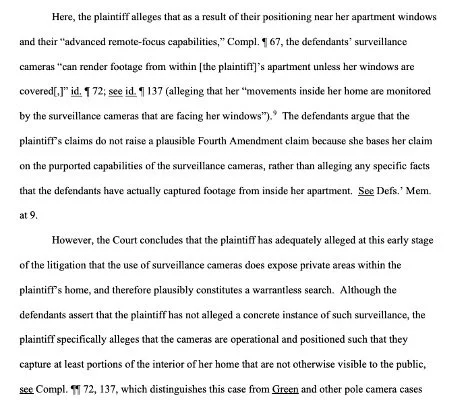
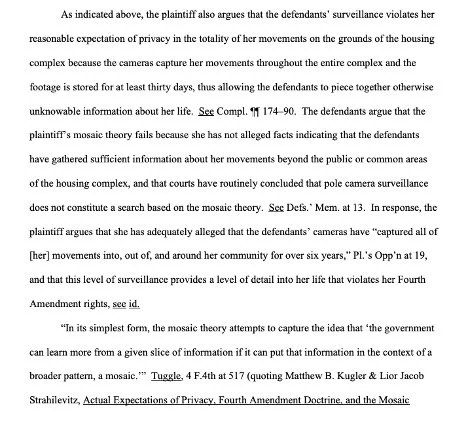
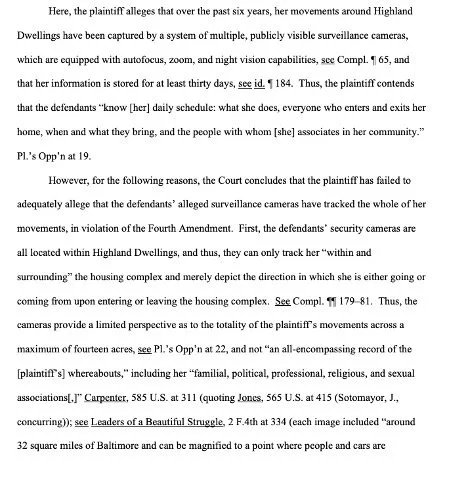
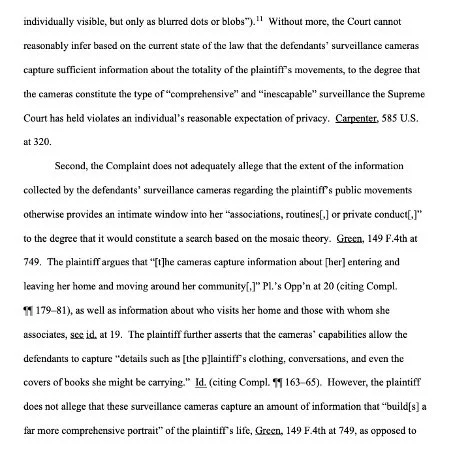
What these excerpts reflect is the court grappling with the limits of current Fourth Amendment doctrine—particularly where traditional “line-of-sight” surveillance meets modern technological capability. But a strong legal argument can still be constructed in the case of Dillon Woods that this surveillance must be enjoined and the cameras removed, even under existing precedent, by reframing the facts through the most protective strands of Supreme Court jurisprudence.
At the foundation is Fourth Amendment to the United States Constitution, which protects not only against physical intrusion, but against unreasonable governmental observation that reveals the privacies of life. The court acknowledges that cameras may capture portions of the home’s interior—this alone is constitutionally decisive. The Supreme Court has repeatedly emphasized that the home is the core of Fourth Amendment protection, and any surveillance that penetrates it without a warrant is presumptively unconstitutional. In Kyllo v. United States, the Court held that even indirect technological observation of a home’s interior constitutes a search. If thermal imaging from outside is unconstitutional, which the Checchi family has done to Dillon Woods with airplanes and drones, then cameras capable of rendering footage from within the house cross an even clearer constitutional line.
The defendants attempt to minimize the intrusion by arguing lack of proof of actual captured footage. But this misstates Fourth Amendment doctrine. The relevant question is not whether the government (or its equivalent) has already viewed private details, but whether it has the capability and positioning to do so. In Kyllo, the Court rejected precisely this kind of argument—the mere use of technology not in general public use to explore details of a home that would previously have been unknowable without physical intrusion is enough. Here, the complaint alleges “advanced remote-focus capabilities” that can see into the home unless windows are covered. That is functionally indistinguishable from the unconstitutional surveillance in Kyllo.
Further, the court’s reliance on pole camera cases like United States v. Tuggle and United States v. Moore-Bush can be distinguished. Those cases typically involve observation of the exterior of a home—driveways, entrances, or curtilage visible from public vantage points. Here, however, the plaintiff alleges that the cameras capture interior spaces not otherwise visible to the public. That distinction is critical. The Fourth Amendment draws a bright line at the entrance to the home, and surveillance that crosses that threshold—even visually—is categorically different from observing what anyone could see from the street.
The court also rejects the plaintiff’s mosaic theory argument, but that rejection can be challenged using Carpenter v. United States. In Carpenter, the Supreme Court held that long-term collection of location data constitutes a search because it reveals the “privacies of life” through aggregation. The court here claims the surveillance is limited to a 14-acre complex, but that framing ignores the duration (six years), continuity, and storage (30 days of retained footage). Even if each individual observation is “public,” the aggregation over time creates a detailed, invasive portrait of the plaintiff’s life—precisely what Carpenter forbids without a warrant.
Additionally, United States v. Jones reinforces that prolonged tracking can violate reasonable expectations of privacy even when movements occur in public. Justice Sotomayor’s concurrence is especially relevant: she warned that sustained surveillance reveals “familial, political, professional, religious, and sexual associations.” The plaintiff here explicitly alleges that the cameras track who enters and exits her home, what they carry, and her daily routines. That is exactly the type of invasive pattern-building that Jones and Carpenter caution against.
The court’s conclusion that the surveillance is not “comprehensive” enough is also vulnerable. The Constitution does not require total surveillance before protections attach. In Katz v. United States, the Court made clear that the Fourth Amendment protects people, not places, and that even limited intrusions into private communications violate constitutional rights. Here, the ability to observe even portions of the home’s interior—combined with long-term tracking of movements—easily meets that threshold.
Another critical angle is the burden shifting implied by the court’s reasoning. By suggesting the plaintiff must prove actual captured footage from inside her home, the court effectively requires her to demonstrate the very invasion she seeks to prevent. This creates a constitutional paradox: the Fourth Amendment is meant to prevent unreasonable searches before they occur, not merely provide remedies afterward. Where surveillance technology is positioned to intrude into the home, courts should err on the side of protection, not permissiveness.
When these doctrines are synthesized, the legal argument becomes clear: this surveillance is not analogous to ordinary security cameras. It is a technologically enhanced, long-term, and capability-driven system that (1) intrudes into the home, (2) aggregates intimate life patterns over time, and (3) operates without a warrant or meaningful limitation. Under Kyllo, Carpenter, and Jones, this constitutes a search—and an unreasonable one.
Therefore, the appropriate remedy is not merely damages but injunctive relief. The cameras must be taken down or repositioned such that they cannot capture any portion of the home’s interior, and any prolonged, aggregated surveillance of the plaintiff’s movements must cease absent a warrant. Anything less would allow precisely the kind of creeping, technology-enabled erosion of privacy that the Fourth Amendment was designed to prevent.
In essence, just as Truman’s world represented total surveillance disguised as normalcy, this case with Dillon Woods and the CIA Checchi family reflects how modern systems can quietly and secretly approach unconstitutional boundaries. The Constitution does not require waiting until surveillance becomes absolute. It requires drawing a firm line—and here, that line has already been crossed for many years in the life of journalist Dillon Woods.
IMPERMISSIBLE USE OF SURVEILLANCE FOR COERCION AND EXPLOITATION
Even if this Court were to consider the surveillance in isolation, its purpose and use render it independently unconstitutional and unlawful. The Fourth Amendment does not merely prohibit unreasonable searches; it also guards against the abuse of surveillance power to control, intimidate, or exploit individuals.
Petitioner alleges that the surveillance system is being used not only to monitor his private life, but to impose penalties and extract money based on observations of his most personal and involuntary bodily functions (such as passing gas). Adam Checchi told Dillon Woods that he “ran the numbers” and found he could make “billions of dollars” by giving “fines” to Dillon Woods and other people for normal bodily functions such as passing gas or burping. Just during the last week of March 2026 Dillon Woods was unjustly fined millions of dollars from such nonsense Checchi family fines (hair too long, not saying ‘thank you,’ tone of voice, room clutter, scratching an itch, burping, and other ridiculous excuses for unjust “fines”). Such use of surveillance—if proven—would represent a profound abuse of power, transforming a monitoring system into a tool of coercion and financial exploitation.
This Court has long recognized that constitutional protections must be interpreted in light of their purpose: to prevent arbitrary and oppressive exercises of power. Surveillance that is used to generate penalties or financial demands based on intimate, private conduct crosses that line. It weaponizes observation and converts it into a mechanism of control. The Honorable Court should demand that all money from all fines given to Dillon Woods, regardless of the date the fine was given, must be returned to Dillon Woods’ account. This may go back to years of financial exploitation.
Moreover, the alleged conduct implicates fundamental principles of due process. Financial penalties imposed outside any lawful framework, without notice, without neutral adjudication, and without the opportunity to challenge the basis for those penalties, violate basic constitutional guarantees. The use of surveillance as the foundation for such penalties only compounds the violation.
Even apart from constitutional doctrine, longstanding common law principles prohibit intrusion upon seclusion and the exploitation of private life for financial gain. Monitoring an individual within their home and then using that information to impose penalties—particularly for inherently private and involuntary human behavior—falls squarely within the type of conduct these doctrines were designed to prevent.
Critically, this alleged exploitation cannot be separated from the surveillance itself. The cameras are not passive or neutral; they are, according to Petitioner, integral to a system that converts private life into a source of financial extraction and exploitation. That purpose underscores why the surveillance must be evaluated not only for its scope, but for its function.
Where surveillance is both intrusive and exploitative, the need for judicial intervention is at its highest. Allowing such a system to continue would not only erode Fourth Amendment protections, but also create a precedent in which surveillance technologies can be used as tools of economic coercion against private individuals.
ARGUMENT
This case presents a direct and profound violation of the Fourth Amendment to the United States Constitution. Petitioner Dillon Woods is subjected to continuous, warrantless surveillance inside his home, including in areas of the highest privacy such as the bathroom and bedroom. If accepted as true—as the record reflects—this conduct is unconstitutional as a matter of law.
The Supreme Court has long held that the home is entitled to the most rigorous Fourth Amendment protection. In Kyllo v. United States, this Court made clear that when the government uses technology to obtain information regarding the interior of a home that could not otherwise be obtained without physical intrusion, a search has occurred. The surveillance at issue here goes even further. It does not merely infer details about the home—it directly captures them. Cameras placed within or directed into Petitioner’s residence eliminate any distinction between technological observation and physical entry. Under Kyllo, such conduct is plainly a search and presumptively unreasonable without a warrant.
The scope and duration of the surveillance independently establish a constitutional violation. In Carpenter v. United States, this Court recognized that prolonged monitoring reveals “the privacies of life” and triggers Fourth Amendment protections even where individual data points may appear innocuous. Here, the surveillance is not episodic or limited—it is continuous and comprehensive, capturing Petitioner’s movements, activities, and personal routines over time. The aggregation of this data creates a detailed portrait of Petitioner’s life that the Constitution does not permit the government—or any entity acting with comparable authority—to obtain without judicial oversight.
This Court’s reasoning in United States v. Jones further reinforces this conclusion. There, the Court recognized that sustained tracking infringes upon expectations of privacy by revealing patterns of association and behavior. Surveillance inside and around the home, especially when conducted continuously, is far more intrusive than the tracking at issue in Jones. It exposes not only where a person goes, but how they live.
Under Katz v. United States, the Fourth Amendment protects people, not places, and applies wherever an individual has a reasonable expectation of privacy. There is no context in which that expectation is stronger than inside one’s home. Indeed, the expectation of privacy in a bathroom or bedroom represents one of the most universally recognized and protected forms of personal privacy. Surveillance in such spaces is not merely invasive—it is fundamentally incompatible with constitutional principles.
The absence of a warrant is dispositive. Warrantless searches are presumptively unreasonable, particularly where they intrude into the home. No exigent circumstances, consent, or recognized exception justifies the level of surveillance described here. To allow such monitoring would be to erase the boundary between public observation and private life, leaving individuals exposed to constant scrutiny without recourse.
Nor can the surveillance be justified by fragmenting it into isolated observations. This Court has rejected attempts to evade constitutional scrutiny by dividing invasive practices into smaller components. The relevant inquiry is the totality of the surveillance—and here, that totality amounts to a system of constant observation that leaves no meaningful sphere of private life intact.
The ongoing nature of this intrusion demands immediate judicial intervention. Where constitutional violations are continuous, this Court has recognized that injunctive relief is necessary to restore fundamental rights. Monetary remedies are insufficient where the harm is the ongoing loss of privacy itself.
CONCLUSION
For these reasons, the Court should hold that continuous, warrantless surveillance of a private residence—including surveillance capable of observing the interior of the home—constitutes an unreasonable search in violation of the Fourth Amendment. The Court should further order that such surveillance cease immediately and that all devices enabling such intrusion be removed or disabled.
QUESTIONS PRESENTED
Whether continuous, warrantless surveillance of a private residence—including the use of cameras capable of observing the interior of the home—constitutes an unreasonable search in violation of the Fourth Amendment to the United States Constitution.
Whether prolonged, technology-enhanced monitoring that aggregates detailed information about an individual’s movements, activities, and personal life infringes upon reasonable expectations of privacy under this Court’s precedents, including Carpenter v. United States and United States v. Jones.
Whether surveillance that intrudes into the most private areas of the home—where expectations of privacy are at their highest—can ever be conducted without a warrant consistent with this Court’s holding in Kyllo v. United States.
SUMMARY OF THE CASE
This case concerns the most fundamental boundary protected by the Constitution: the right of an individual to be secure within his own home. Petitioner Dillon Woods seeks relief from continuous, warrantless surveillance conducted through a network of cameras placed inside and outside his residence. These cameras are capable of capturing and recording Petitioner’s daily life, including activity within the interior of the home and in areas of the highest personal privacy.
The surveillance is not limited in scope or duration. It operates continuously, collecting extensive visual and audio information and creating a comprehensive record of Petitioner’s movements, associations, and private activities. The result is a level of intrusion that leaves no meaningful sphere of personal privacy intact.
This Court has repeatedly held that the home occupies a central place in Fourth Amendment jurisprudence. In Katz v. United States, the Court established that the Constitution protects people where they have a reasonable expectation of privacy. That expectation reaches its apex inside the home. In Kyllo v. United States, the Court made clear that the use of technology to obtain information about the interior of a home constitutes a search. And in Carpenter v. United States, the Court recognized that long-term, aggregated surveillance reveals the privacies of life and triggers constitutional protection.
The surveillance at issue here implicates all of these principles. It is technologically enhanced, continuous, and directed at the home itself. It does not merely observe what is exposed to public view; it penetrates the private sphere the Fourth Amendment was designed to protect.
Absent a warrant, consent, or exigent circumstances, such surveillance is presumptively unreasonable. Yet the monitoring described here persists without judicial authorization or meaningful limitation. If permitted, it would erode the distinction between public observation and private life, allowing constant surveillance to become normalized in spaces where privacy has always been most sacred.
This case therefore presents a question of exceptional importance: whether the Constitution permits a system of surveillance that effectively eliminates privacy within the home. Petitioner respectfully submits that it does not, and that the Fourth Amendment requires the immediate cessation of such practices and the restoration of his right to be secure in his person and home.
SUPREME COURT OF THE UNITED STATES
Petitioner: Dillon Woods
v.
Respondents: [Defendants Alleged to Conduct Surveillance]
BRIEF FOR PETITIONER
Petitioner Dillon Woods seeks relief from sustained and intrusive surveillance that violates the Fourth Amendment to the United States Constitution, which guarantees the right of individuals to be secure in their persons, houses, papers, and effects against unreasonable searches. This case presents a fundamental constitutional question: whether prolonged, technology-enhanced surveillance directed at a private individual—capable of capturing details inside the home and tracking daily life—can persist without judicial oversight.
At the core of this case is the sanctity of the home. The Supreme Court has repeatedly held that the home is entitled to the highest level of constitutional protection. In Kyllo v. United States, the Court ruled that technology used to obtain information about the interior of a home that could not otherwise be obtained without physical intrusion constitutes a search. If surveillance devices are positioned or capable of observing activity within Petitioner’s residence, such conduct falls squarely within the prohibition articulated in Kyllo.
The Petitioner further asserts that the surveillance is not isolated, but continuous and systematic. In Carpenter v. United States, this Court recognized that long-term tracking and aggregation of data reveals deeply private details about an individual’s life and therefore constitutes a search under the Fourth Amendment. Even where individual observations may appear innocuous, their accumulation over time creates a detailed portrait of a person’s movements, associations, and habits—precisely the type of intrusion the Constitution forbids without a warrant.
Similarly, in United States v. Jones, the Court acknowledged that prolonged surveillance infringes upon reasonable expectations of privacy. The concern is not merely physical trespass, but the ability of surveillance to reconstruct a person’s private life. If Petitioner is being monitored in a manner that reveals patterns of behavior, visitors, or personal routines, such monitoring exceeds constitutional limits.
The standard established in Katz v. United States further supports Petitioner’s claim. The Fourth Amendment protects people, not places, and applies wherever an individual has a reasonable expectation of privacy. A person inside their home possesses the highest expectation of privacy recognized under the law. Surveillance that intrudes upon that expectation—whether directly or through technological enhancement—constitutes an unreasonable search.
Importantly, the Constitution does not require a plaintiff to prove that every private moment has already been captured. It is sufficient that surveillance systems are capable of intruding into protected spaces or are configured in a way that enables such intrusion. To require proof of actual captured footage would invert the Fourth Amendment’s purpose, which is to prevent unlawful searches before they occur.
Petitioner also raises concerns about the purpose and use of surveillance, alleging that it is being used in a manner that causes harm, distress, and coercion. While courts require verifiable evidence for specific claims of misuse, the broader constitutional principle remains clear: surveillance cannot be deployed in a way that harasses, intimidates, or exploits an individual without lawful authority.
The remedy sought is narrowly tailored and constitutionally appropriate. Petitioner requests injunctive relief requiring that any surveillance devices be removed, disabled, or repositioned such that they cannot observe the interior of the home or track private activity over time. This Court has long recognized that where constitutional violations are ongoing, injunctive relief is necessary to restore fundamental rights.
This case ultimately concerns more than one individual. It addresses whether advancing surveillance technologies can erode the boundary between public observation and private life. If left unchecked, such practices would undermine the core guarantee of the Fourth Amendment and normalize a level of intrusion incompatible with a free society.
For these reasons, Petitioner respectfully requests that this Court affirm that continuous, technology-enhanced surveillance of a private individual—particularly where it implicates the home—constitutes an unreasonable search, and that appropriate relief be granted to restore constitutional protections.
SUPREME COURT OF THE UNITED STATES
Dillon Woods, Petitioner
v.
Respondents
QUESTIONS PRESENTED
Whether continuous, warrantless surveillance of a private residence—including cameras capable of observing the interior of the home—constitutes an unreasonable search in violation of the Fourth Amendment to the United States Constitution.
Whether prolonged, technology-enhanced monitoring that aggregates detailed information about an individual’s movements, activities, and private life infringes upon reasonable expectations of privacy under this Court’s precedents, including Carpenter v. United States and United States v. Jones.
Whether surveillance used as a tool of coercion or financial exploitation—derived from monitoring an individual’s most private conduct—violates constitutional protections, including the Fourth Amendment and principles of due process.
SUMMARY OF THE CASE
This case concerns the most fundamental boundary protected by the Constitution: the right of an individual to be secure within his own home. Petitioner Dillon Woods seeks relief from continuous, warrantless surveillance conducted through a network of cameras placed inside and outside his residence. These cameras are capable of capturing and recording Petitioner’s daily life, including activity within the interior of the home and in areas of the highest personal privacy.
The surveillance is constant, comprehensive, and technologically enhanced. It captures not only isolated moments, but the totality of Petitioner’s life—his movements, routines, associations, and private activities. The result is an environment in which no meaningful expectation of privacy remains.
This Court has repeatedly held that the home occupies a central place in Fourth Amendment jurisprudence. In Katz v. United States, the Court established that the Constitution protects people where they have a reasonable expectation of privacy. In Kyllo v. United States, the Court held that technology used to obtain information about the interior of a home constitutes a search. And in Carpenter v. United States, the Court recognized that long-term surveillance reveals the privacies of life and triggers constitutional protection.
The surveillance at issue implicates all of these principles. It is directed at the home, operates continuously, and reveals the most intimate aspects of Petitioner’s life. It occurs without a warrant, without consent, and without any recognized legal justification.
Compounding this intrusion, Petitioner alleges that the surveillance is used not merely for observation, but as a mechanism of coercion and financial exploitation. The monitoring of private, involuntary human behavior is allegedly used as the basis for imposing penalties and extracting money from Petitioner. Such use of surveillance transforms it from an intrusion into a tool of control.
This case therefore presents a question of exceptional constitutional importance: whether a system of surveillance that eliminates privacy within the home and exploits the resulting information for coercive purposes can be reconciled with the Fourth Amendment. Petitioner respectfully submits that it cannot.
ARGUMENT
I. Continuous, Warrantless Surveillance of the Home Is Per Se Unconstitutional
The Fourth Amendment draws its firmest line at the entrance to the home. Surveillance that intrudes into the interior of a residence—whether by physical entry or technological means—constitutes a search.
In Kyllo v. United States, this Court held that the use of technology to obtain information about the interior of a home that could not otherwise be obtained without physical intrusion is a search. The surveillance described here exceeds that threshold. It does not merely infer details; it directly captures them. Cameras placed within or directed into the home eliminate any meaningful distinction between observation and entry.
Such surveillance, conducted without a warrant, is presumptively unreasonable and therefore unconstitutional.
II. Prolonged and Aggregated Surveillance Violates Reasonable Expectations of Privacy
Even if considered in isolation, the duration and scope of the surveillance independently establish a constitutional violation.
In Carpenter v. United States, this Court recognized that long-term monitoring reveals “the privacies of life.” Similarly, in United States v. Jones, the Court acknowledged that sustained surveillance exposes patterns of behavior and association that society recognizes as private.
Here, the surveillance is continuous and comprehensive. It captures not only where Petitioner goes, but how he lives. The aggregation of this information creates a detailed and intrusive portrait of his life that the Fourth Amendment does not permit without judicial oversight.
III. Surveillance of the Home’s Most Private Spaces Is Constitutionally Intolerable
Under Katz v. United States, the Fourth Amendment protects people where they have a reasonable expectation of privacy. That expectation is at its apex within the home—and within the most private areas of the home.
Surveillance in spaces such as bathrooms represents one of the clearest imaginable violations of privacy. It is not merely unreasonable; it is fundamentally incompatible with the constitutional guarantee of personal security.
No doctrine, exception, or balancing test permits such intrusion without a warrant.
IV. Use of Surveillance as a Tool of Coercion and Financial Exploitation Is Independently Unlawful
The Constitution does not permit surveillance to be used as a mechanism of control or exploitation. Petitioner alleges that the surveillance system is used to impose penalties and extract money based on observations of his private life.
If proven, such conduct would violate not only the Fourth Amendment but also fundamental principles of due process. Financial penalties imposed without lawful process, and derived from invasive monitoring of private conduct, represent an arbitrary and oppressive exercise of power.
Additionally, such conduct aligns with well-established prohibitions against intrusion upon seclusion and the exploitation of private information for gain. Surveillance that converts private life into a source of financial extraction cannot be justified under any legitimate legal framework.
V. Injunctive Relief Is Necessary to Restore Constitutional Protections
The violations described here are ongoing. Where constitutional rights are continuously infringed, injunctive relief is the appropriate remedy.
Petitioner respectfully requests that this Court order:
The immediate cessation of all surveillance directed at his residence;
The removal, disabling, or repositioning of any cameras or devices capable of observing the interior of the home;
Such additional relief as necessary to restore Petitioner’s right to privacy and security.
CONCLUSION
The Fourth Amendment does not permit a world in which an individual is subjected to constant, warrantless surveillance within his own home. It does not permit the aggregation of intimate details of a person’s life without judicial oversight. And it does not permit the use of such surveillance as a tool of coercion or exploitation.
For these reasons, the Court should hold that the surveillance at issue is unconstitutional and order its immediate termination.
April 17, 2026
From: Dillon Woods
Dillon.Woods@CrisisJournalism.com
To: Supreme Court of the United States
1 First Street, NE
Washington, DC 20543
Re: Request for Consideration of Constitutional Protections for AI-Assisted Legal Communications
I respectfully submit this letter in connection with my pending matter before the Court, seeking recognition of constitutional protections for legal communications conducted by pro se litigants through artificial intelligence tools.
This issue presents a novel but increasingly urgent question: whether fundamental legal protections—long recognized as essential to the fair administration of justice—will evolve to remain accessible to those who lack the financial means to retain traditional legal counsel.
At the core of this request are five interrelated legal principles, each grounded in established precedent and constitutional doctrine.
First, denying privilege or confidentiality protections to AI-assisted legal communications effectively undermines the constitutional right of access to the courts. This Court has made clear that access must be meaningful, not merely theoretical. When a pro se litigant is forced to prepare legal arguments without the ability to communicate confidentially, the adversarial process becomes fundamentally imbalanced. Artificial intelligence tools, for individuals in my position, serve as the only viable means of interpreting complex legal frameworks and participating in litigation in a meaningful way.
Second, conditioning confidentiality protections on the ability to afford licensed counsel creates a structural inequality that is incompatible with the Equal Protection Clause. This Court has consistently rejected systems in which justice depends upon financial status. Yet under current interpretations, those with resources benefit from protected legal communications, while indigent litigants are denied equivalent protections when using modern tools to perform the same functions. This disparity creates a two-tiered system of justice that is neither equitable nor constitutionally sound.
Third, longstanding doctrine supports extending privilege protections to necessary intermediaries. The principles articulated in cases recognizing the role of agents—such as translators, experts, and consultants—demonstrate that privilege is not limited strictly to direct attorney-client exchanges when additional assistance is required to facilitate legal understanding. Artificial intelligence serves a comparable function for pro se litigants, acting as a necessary interface through which legal reasoning becomes accessible. Treating such use as a waiver of confidentiality elevates form over function and undermines the purpose of the privilege itself.
Fourth, even where traditional attorney–client privilege is not recognized, the work-product doctrine provides an independent and compelling basis for protection. Materials prepared in anticipation of litigation, including mental impressions, legal theories, and strategic analysis, have long been shielded from disclosure. My use of artificial intelligence tools is confined entirely to these protected categories. To deny work-product protection based solely on the medium through which such materials are developed would represent a significant and unjustified departure from established doctrine.
Fifth, this issue carries substantial national importance. As artificial intelligence becomes increasingly integrated into the practice of law and the broader public’s access to legal information, the absence of clear guidance risks widespread inconsistency and systemic disadvantage for pro se litigants. Without intervention, existing legal frameworks—developed in a pre-digital era—will continue to produce outcomes that disproportionately burden those without financial resources.
For these reasons, I respectfully urge the Court to consider whether existing constitutional principles require recognition of confidentiality protections for AI-assisted legal communications, or, at minimum, to clarify that such materials fall within the scope of the work-product doctrine.
This is not merely a question of technological adaptation. It is a question of whether the foundational guarantees of fairness, equality, and access to justice will remain meaningful in the modern era.
Respectfully submitted,
Dillon Woods
Independent Journalist
https://www.CrisisJournalism.com/latest-news-update
*I use ChatGPT as an editing and drafting tool under my direction to improve clarity and flow.
Enclosures (copied below): Motion for Recognition of Privilege Protection for AI-Assisted Legal Communication
IN THE
SUPREME COURT OF THE UNITED STATES
DILLON WOODS,
Petitioner,
v.
CIA CHECCHI FAMILY, et al.,
Respondents.
MOTION FOR RECOGNITION OF PRIVILEGE PROTECTION FOR AI-ASSISTED LEGAL COMMUNICATIONS
QUESTION PRESENTED
Whether the Constitution permits denial of attorney–client privilege and/or work-product protection to a pro se litigant who relies on artificial intelligence tools for legal analysis, where such denial effectively conditions confidential legal access on the ability to afford licensed counsel.
STATEMENT OF THE CASE
Petitioner, Dillon Woods, is a journalist and pro se litigant engaged in ongoing legal proceedings against the CIA Checchi family and associated actors. Petitioner alleges sustained violations of constitutional rights, including interference with his work, suppression of speech, and systemic abuse of power.
Due to lack of financial resources, Petitioner is unable to retain licensed legal counsel. As a result, Petitioner relies on artificial intelligence tools, including ChatGPT, to perform essential legal functions, including:
• Legal research
• Drafting pleadings
• Interpreting statutes and case law
• Developing litigation strategy
Petitioner’s communications with such tools are often made exclusively for the purpose of obtaining legal guidance and preparing for litigation.
However, under existing interpretations of attorney–client privilege, such communications may be treated as disclosures to a third party, thereby stripping them of confidentiality protections solely because Petitioner cannot afford a human attorney.
REASONS FOR GRANTING THE MOTION
I. DENYING PRIVILEGE TO AI-ASSISTED PRO SE LITIGANTS VIOLATES THE CONSTITUTIONAL RIGHT OF ACCESS TO THE COURTS
This Court has long recognized that meaningful access to the courts is a fundamental right. Bounds v. Smith, 430 U.S. 817 (1977).
For many litigants, artificial intelligence tools serve as the functional equivalent of legal assistance. Denying confidentiality to such communications renders that access illusory.
If a litigant cannot communicate confidentially while preparing legal arguments, then their ability to effectively pursue claims is fundamentally compromised. Recently, the CIA Checchi family orchestrated an attack on the home of OpenAI / ChatGPT CEO Sam Altman. On April 10, 2026 (early morning Friday), a 20-year-old suspect threw a Molotov cocktail at Altman’s home. Two days later, April 12, 2026, a vehicle stopped near Altman’s home and shots were fired by a gunman. Two individuals were later arrested. These acts of violence were orchestrated to intimidate Mr. Altman into giving the CIA Checchi family access to ChatGPT, because Mr. Woods was using ChatGPT to write responses to the Supreme Court regarding his case against the CIA Checchi family. The Checchi family sought to make ChatGPT less efficient, and they wanted to make Mr. Woods court responses less effective. This conduct of Kathy Checchi, Al Checchi, Adam Checchi, David Kanuth, Michael Fisher, Oprah Winfrey, and other CIA Checchi family cult leaders constitutes clear witness tampering and obstruction of justice. Steps must be taken to protect Mr. Woods work on ChatGPT.
II. CONDITIONING CONFIDENTIAL LEGAL PROTECTION ON WEALTH VIOLATES EQUAL PROTECTION PRINCIPLES
This Court has made clear that justice cannot depend on the ability to pay for expert and professional legal help. Griffin v. Illinois, 351 U.S. 12 (1956).
Under current doctrine:
• Wealthy litigants receive privileged communications with attorneys
• Indigent litigants using AI tools receive no such protection
This creates a two-tiered system of justice in which confidentiality—a cornerstone of legal advocacy—is available only to those with financial means.
Such a system violates the Equal Protection Clause by imposing structural disadvantage based solely on economic status.
III. AI FUNCTIONS AS A NECESSARY LEGAL INTERMEDIARY UNDER ESTABLISHED PRIVILEGE PRINCIPLES
This Court has recognized that attorney–client privilege extends to agents necessary to facilitate legal advice. United States v. Kovel, 296 F.2d 918 (2d Cir. 1961).
Artificial intelligence tools serve a function analogous to:
• Legal research assistants
• Translators of complex legal doctrine
• Drafting aides
For a pro se litigant, AI is not a voluntary third-party disclosure but a necessary interface for accessing legal reasoning.
Denying privilege on the basis that AI is a “third party” ignores its functional role and undermines the purpose of the privilege itself.
IV. AT MINIMUM, AI-ASSISTED LEGAL COMMUNICATIONS CONSTITUTE PROTECTED WORK PRODUCT
Even if attorney–client privilege is not extended, Petitioner’s communications are protected under the work-product doctrine.
In Hickman v. Taylor, 329 U.S. 495 (1947), this Court held that materials prepared in anticipation of litigation—including mental impressions, strategies, and legal theories—are protected from disclosure.
Petitioner’s use of ChatGPT often consists of:
• Draft legal arguments
• Strategic analysis
• Case preparation
• Legal Research
These are quintessential forms of protected work product.
To deny such protection merely because the medium of preparation involves AI would undermine the doctrine’s core purpose.
V. THIS CASE PRESENTS A QUESTION OF NATIONAL IMPORTANCE IN THE DIGITAL AGE
As artificial intelligence becomes an increasingly common tool for legal assistance, the question presented here will affect:
• Millions of pro se litigants
• The future of legal access in the United States
• The integrity of constitutional protections in a technological era
Absent guidance from this Court, lower courts will continue to apply outdated frameworks that fail to account for modern realities, thereby systematically disadvantaging those without financial resources.
CONCLUSION
Petitioner respectfully requests that this Court recognize that:
1. Communications between a pro se litigant and AI legal tools such as ChatGPT that are used for the purpose of legal advice are entitled to protection under principles analogous to attorney–client privilege; or
2. In the alternative, such communications are protected under the work-product doctrine; and
3. Denial of such protections based solely on a litigant’s inability to afford counsel violates the Constitution.
Respectfully submitted,
Dillon Woods
Independent Journalist
https://www.CrisisJournalism.com/latest-news-update
*I use ChatGPT as an editing and drafting tool under my direction to improve clarity and flow.