Honesty From Government Agents
I’ve been told that a federal judge has declared that government agents (people representing the government) do not have a constitutional requirement to be honest in their dealings with the public. The plaintiffs are essentially asking the court to invent a new constitutional right: a “right to be free from exposure to deceit.” The judges therefore ask whether that precise right is “deeply rooted” in American history and tradition and they conclude that it isn't.
With respect and deference to the honorable judges, this article is in response to what I believe to be a misguided, short-sighted, and incorrect pronouncement from the bench in this situation. Since I am the one, central person on which this operation is focused, I have some things to say about this.
In practical terms, this is being brought to the court regarding my situation with the corrupt CIA Checchi family whose entire empire is founded on lies, deceit, manipulation, fraud, duplicity, and extreme abuse of power. This ruling allows this corrupt family to continue their criminal enterprise. That alone is seriously objectionable.
This situation has to do with how the CIA Checchi family has been using me since 2003 as “bait” to kill secret society people – from which they make billions of dollars terminating “threats to national security.” What they are actually doing in many cases is a genocide of people with a low IQ – people who believe fairy tales and are easily manipulated.
The Checchi family cult leaders have made billions and billions of dollars in this government operation. They continue to try to force me to be used in this way because they have “run the numbers” and figure that they could make as much as 600 billion dollars from continuing to use me in this way. I object to being used in this way for a variety of reasons.
The Checchi family deceives these secret society people with lies about me (for example, that I’m a child predator) and then these secret society members spread lies about me (the crime of slander) and some of these secret society people even try to kill me (the crime of attempted murder). Through all this drama, the CIA Checchi family gets to enslave and sometimes even kill, these secret society people.
The Constitution gives them the power to enslave anyone who commits a crime (slander or murder, in this case). The thirteenth amendment abolishes slavery, “except as a punishment for crime.” But does the Constitution give them the power to deceive and lie to the public they are sworn to serve in service to the Constitution? This entire “Special Operation” is founded on deceit and lies. So, the problem brought to the courts is about the legality of government agents lying to secret society people who are part of the public that they serve. Does the Constitution demand honesty when dealing with the public? These judges say no, it does not.
First, there is a big difference between “the government failed to provide adequate details of this operation to the public” and “the government affirmatively created or increased a physical danger to people, then concealed the danger from them.” Failing to warn someone about a danger is one thing. Creating the danger, knowing about it, and then telling the person, “You’re safe,” is something fundamentally different. We should not accept a government that does the latter, and the court is in serious error for establishing such a standard and then suggesting that the Constitution allows such nonsense. This ruling reminds me of the cheap gas station down the street that offers very low-octane fuel. Truth is the oxygen of the constitutional system. In other words, this is low-octane legal reasoning. It may be enough to keep the judicial engine running, but it is not the quality of fuel required to power a constitutional system worthy of a nation founded on the promise of “justice for all.”
Once a court veers away from common sense, it veers away from the common people and no longer serves the common person. Many judges and attorneys have highly refined educations and spend their days immersed in complicated and sophisticated legal theories. The common people have something much more basic: common sense. When judicial professionals become so consumed by legal theories that they can no longer recognize the obvious difference between failing to warn people about a danger and deliberately creating a danger, concealing it and assuring people that they are safe, they have entered a world disconnected from the very people the law is supposed to protect and serve.
My final point is that one must look at the legal profession and realize that it is not only rooted in the Constitution, but it also exists in an atmosphere that is invisible. One can look at a tree, for example, and acknowledge that the tree has roots that help it survive and make it what it is. But the tree does not only exist because of its roots. It exists also because of the atmosphere in which it lives. An atmosphere with an invisible dimension: oxygen. “Honesty” in the Constitution and from government agents is the oxygen in which the Constitution and the judicial world exist.
This is why, for example, honesty and integrity are part of the ethical code of attorneys and judges. The constitution may not say anything about honesty or include the word “honesty.” But good faith and honesty were part of the atmosphere in which the founders wrote the Constitution. And to this day, the Constitution continues to live in an atmosphere where honesty is demanded. The judges who are asking whether honesty is a right “deeply rooted” in the Constitution, American history and tradition miss the point when they conclude that it isn't. It may not be part of the roots (explicitly written in the Constitution) but it is part of the atmosphere.
If I may extend one last analogy from the tree into the judicial world, I would say that a tree needs oxygen to live, and through its own natural processes, contributes oxygen back into the environment that sustains life. The judicial system works in much the same way with honesty. It needs honesty to function, and through its rules, oaths, ethical standards, sworn testimony and judgments, it is supposed to reinforce and produce honesty throughout the legal system. Without honesty going into the system, the system cannot reliably produce justice coming out of it. Truth is not merely an ingredient of the judicial process. It is part of the atmosphere in which the entire system must live.
The professional rules governing lawyers and judges may not, standing alone, constitute proof that the Constitution contains an explicitly written, general and enforceable “right to truth.” But that is too narrow a way of looking at the Constitution. Those rules establish something far more fundamental: they establish the legal and ethical atmosphere in which the Constitution operates. Truthfulness is the oxygen of the constitutional system.
The courts cannot function without it. The rule of law cannot function without it. Due process cannot function without it. Judicial decisions cannot function without it. The administration of justice cannot function without it. Government accountability cannot function without it.
A lawyer cannot knowingly deceive a court and then argue that deception is permissible simply because the Constitution contains no sentence specifically stating, “An attorney shall not lie.” The legal system understands that honesty is not merely another rule sitting beside the Constitution. It is a prerequisite to the system's ability to function at all.
The same reasoning should apply to government itself. The Constitution establishes a government of laws rather than a government of arbitrary power. It distributes governmental authority, imposes limitations upon that authority, protects individual liberty and provides mechanisms through which government officials can be held accountable. Every one of those mechanisms presupposes a basic level of governmental honesty. Without truth, due process becomes an illusion. Without truth, judicial review becomes an exercise based upon manufactured facts. Without truth, government accountability becomes impossible. Without truth, the people's ability to consent to and participate in their government is corrupted at its foundation.
This does not mean that every inaccurate statement made by a government employee automatically becomes a constitutional violation. That would be an absurd and unworkable rule. The constitutional problem arises when deception is intentional and consequential—when government officials knowingly manipulate the factual circumstances upon which citizens must rely in exercising fundamental decisions about their lives, liberty, safety or property.
That distinction is critical in this case with the corrupt CIA Checchi family terrorists. The question isn't simply whether citizens possess an abstract constitutional entitlement to receive accurate government information. The question is whether government officials exercising public power can knowingly conceal a dangerous condition, affirmatively tell citizens that the danger does not exist, and then escape constitutional scrutiny by declaring that the Constitution never expressly created a “right to truthful information.”
That reasoning turns constitutional silence into governmental permission. But constitutional silence does not necessarily mean permission. The Constitution does not enumerate every act that government is forbidden to commit. It establishes principles and structures within which governmental power must be exercised. And it was created in a very specific atmosphere of good faith, integrity, common sense and heartfelt honesty.
The professional obligations imposed upon lawyers and judges are therefore relevant—not because their ethical codes magically create constitutional rights, but because they reveal the legal culture (the atmosphere) and institutional assumptions upon which the American system of justice rests. They demonstrate that truthfulness is understood by the legal system as a condition of legitimate adjudication. And government is not entitled to a lower standard of integrity than the lawyers and judges who administer its laws. Indeed, the opposite should be true.
A private lawyer owes candor, truthfulness, and sincerity to a court because the integrity of the judicial system depends upon it. A judge owes integrity to the judicial process because the legitimacy of judicial power depends upon it. A government official exercising sovereign authority owes an even more fundamental duty of good faith to the citizens over whom that authority is exercised.
Truth is therefore not merely a desirable characteristic of constitutional government. It is a structural necessity. It is the oxygen in which the Constitution breathes. Remove it, and the document may remain physically intact, but the constitutional system it created cannot function as intended.
That is why the absence of the words “right to truth” from the Constitution should not end this conversation. The more important question is whether a constitutional government can remain constitutional when those exercising its power are permitted to deliberately deceive the people about a danger the government itself has created.
If the answer is yes, then the government possesses a power that the Constitution never expressly granted: the power to manipulate the factual reality upon which citizens must base the exercise of their own liberty. That is not an insignificant omission. It strikes at the foundation of constitutional government itself. All attorneys and judges who work in the field of law are bound to uphold standards against deceit and fraud. Lawyers have explicit duties of candor and honesty, and serious violations can lead to discipline or disbarment; judges likewise have judicial-ethics obligations.
The Constitution does not have to enumerate every prerequisite of constitutional government. The absence of a constitutional sentence saying “the government shall not knowingly lie to its citizens” should not be mistaken for a constitutional permission to deceive them.
This is not an abstract constitutional argument for me. It is personal. My part in this CIA Checchi family “Special Operation” should end immediately. I do not consent to being part of such a scheme, and there is clear evidence that it involves the genocide of people with a low IQ or who are too trusting, naïve, gullible and easily influenced through “sophisticated” games of manipulation. It is also human trafficking for profit because the Checchi family has made billions of dollars from this operation while I have not been paid one penny for my role in it. Furthermore, my involvement was predicated on deceit because the Checchi family lied to me about what was really going on as people were attacking me and trying to kill me. They placed the blame on the family of LBJ and the Bush families in Texas. In reality, it was the CIA Checchi family orchestrating the entire thing.
For more than three decades, the Checchi family has disrupted my professional engagements and sabotaged my career, with lasting consequences that include lower Social Security payments. If government power has been used against me in the manner I have described, then the principles discussed throughout this article are not academic. They are fundamental questions of truth, accountability and justice. I should immediately be paid the restitution that the court has ordered me to receive, together with the interest that has accumulated since 2019, when the Checchi family began their efforts to prevent that money from reaching me.
I am asking for nothing more than an end to the deception, an accounting of what has happened, and the enforcement of the rights and remedies that already exist. If truth is truly the oxygen of our constitutional system, then it must apply to ordinary people as well as those who exercise government power.
Thank you for any help you can offer to bring this nightmare to an end. Thank you for your time and consideration,
Dillon Woods
Independent Journalist
https://www.CrisisJournalism.com/latest-news-update
* My writing is often edited and improved using ChatGPT.
My books are at this link and your support is appreciated: www.amazon.com/author/dillonwoods.

September 2, 2026 – Another shooting in Minnesota today when the CIA Checchi terrorists receive word of their “life in prison” sentence for their crimes. This Checchi family clown show has been going on for years. Thousands of people have been killed. Some politicians say, “the price of holding them accountable is too high.” Other judicial leaders say, “the cost of not holding them accountable is even higher.”
Dear ChatGPT, here's a situation: CIA Checchi family terrorists, with CIA badges, keep orchestrating terrorist events to get out of punishments for terrorist events they created in the past. Their punishments get washed away and then, after some time, they are given punishments again and the cycle continues for many years. This is obviously unsustainable for democracy. At the same time, a person wins a court case against these Checchi family terrorists, and he gets a financial court ordered settlement. When the government goes to give the money to him, the Checchi terrorists create terrorist events to stop the money from going to him. Politicians say, "we can't give the person justice because the price for giving him the money is too high." Obviously, what they do is not about the "rule of law." On one hand, it is practical people (don't give any money) against the idealistic people (this is not how a democracy works. Give the guy the money). This goes back and forth for seven years. Thousands of people are dead in the meantime from these Checchi terrorist's outbursts. If they would have just given the guy the money, all these people would not be dead. The people with blood on their hands are the people who pulled the money. Take this situation and create an analogous story that will help people who have no experience at this kind of situation, understand what is going on.
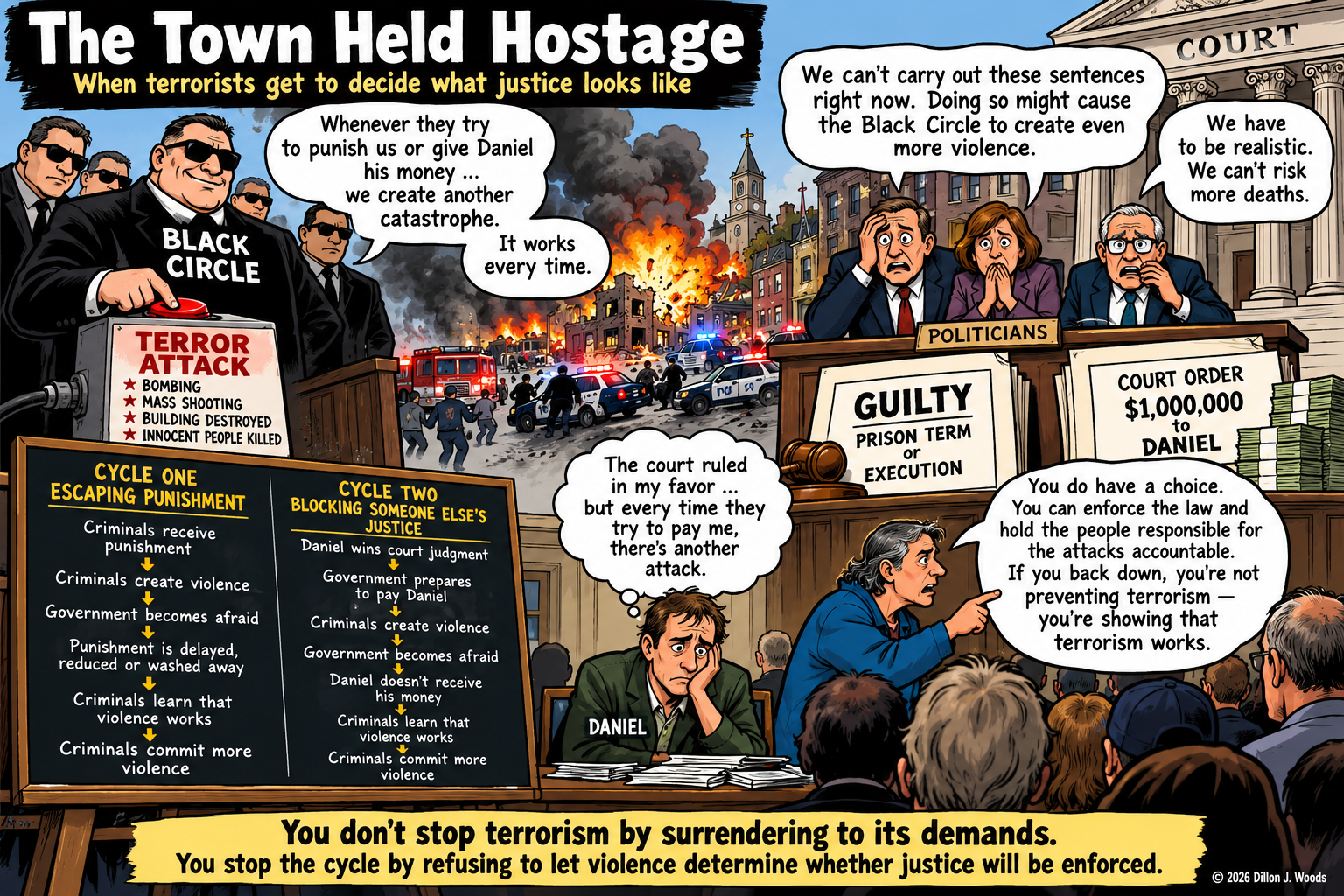
The Town Held Hostage
Imagine a town controlled by a powerful criminal organization called the Black Circle. The members of the Black Circle have committed terrible crimes, and eventually the town's courts begin prosecuting them.
The courts hand down serious punishments. Some members are sentenced to long prison terms. Others receive the town's ultimate punishment.
But the Black Circle has discovered a way to fight the punishments without appealing the verdicts.
Whenever one of their members is about to be imprisoned or executed, the organization creates another catastrophe in the town.
A bombing. A mass shooting. A building destroyed. Innocent people killed.
The politicians panic.
They say:
“We can't carry out these sentences right now. Doing so might cause the Black Circle to create even more violence.”
So, the punishments are delayed.
Eventually, the crisis fades. The town returns to normal. The government once again tries to enforce the original sentences.
The Black Circle responds with another catastrophe.
Again, the politicians back away.
This happens over and over.
The Black Circle has effectively discovered something extraordinary:
“If we create enough violence, we can make the government afraid to punish us.”
The punishment itself has become a trigger for another terrorist attack—not because the punishment causes the attack, but because the criminals have deliberately chosen terrorism as their response to punishment.
And because backing down works, they keep doing it.
Meanwhile, Something Else Is Happening
At the same time, an ordinary man named Daniel wins a completely separate court case against the Black Circle.
After years of litigation, the court rules that Daniel is legally entitled to $1 million.
The government prepares to give Daniel his money.
But the Black Circle doesn't want Daniel to receive it.
So they use the same strategy.
Whenever the government gets close to paying Daniel, the Black Circle creates another catastrophe.
People are killed. The town is thrown into chaos. Politicians become frightened.
And then the politicians say:
“We can't give Daniel his $1 million right now. Every time we try, people die.”
So, Daniel doesn't get paid.
Months later, the government tries again.
Another catastrophe.
The government backs away again.
Eventually the politicians begin describing themselves as the “practical” people.
They say:
“Of course, Daniel deserves his money. The court ruled in his favor. But we have to be realistic. We can't risk thousands of lives just to give one man $1 million.”
But something has gone terribly wrong with that reasoning.
The Black Circle has now learned two things:
When the government tries to punish us, create violence and the punishment may disappear.
And:
When the government tries to give our opponent his court-ordered money, create violence and the payment may disappear.
So the organization has created a system in which violence controls both sides of justice.
Seven Years Later
Seven years pass.
The pattern has become almost automatic.
A Black Circle member faces punishment → terrorist attack → punishment delayed or reduced.
Daniel is about to receive his court-ordered money → terrorist attack → payment delayed or canceled.
The violence continues.
Thousands of innocent people are dead.
And politicians keep saying:
“We're doing this to prevent more deaths.”
Finally, someone stands up at a town meeting and asks:
“Why are we allowing the Black Circle to decide what happens?”
The politicians respond:
“What choice do we have? Whenever we enforce the law, they create another disaster.”
The person answers:
“You absolutely have a choice. You can enforce the law and hold the people responsible for the attacks accountable for the attacks.”
“You are treating their terrorism as though it were a natural consequence of justice. It isn't. They are making a choice.”
“If you cancel someone's punishment because they threaten violence, you haven't stopped terrorism. You've demonstrated that terrorism works.”
“And if you cancel Daniel's lawful payment because someone threatens violence, you haven't protected Daniel. You've demonstrated that violence can veto a court judgment.”
Then comes the most important point:
“You are not actually choosing between justice and violence. You are choosing whether the people committing the violence get to control justice.”
The Two Cycles
The town finally draws the two cycles on a blackboard:
CYCLE ONE — ESCAPING PUNISHMENT
Criminals receive punishment
↓
Criminals create violence
↓
Government becomes afraid
↓
Punishment is delayed/reduced/washed away
↓
Criminals learn that violence works
↓
Criminals commit more violence
CYCLE TWO — BLOCKING SOMEONE ELSE'S JUSTICE
Daniel wins court judgment
↓
Government prepares to pay Daniel
↓
Criminals create violence
↓
Government becomes afraid
↓
Daniel doesn't receive his money
↓
Criminals learn that violence works
↓
Criminals commit more violence
And then the town realizes something horrifying:
These aren't two separate problems. They're two applications of the same weapon.
The Black Circle is using terrorism as a veto over the justice system.
When the law moves against them, they use violence to stop it.
When the law moves for their opponent, they use violence to stop that too.
The result is that the criminals don't have to win their court cases.
They don't have to prove their innocence.
They don't have to defeat the government's arguments.
They only have to create enough bloodshed to make government officials afraid to enforce the law.
And once that happens, the terrorists effectively become the people deciding what the law means.
That is why the central question isn't:
“Is justice worth the price of more violence?”
It is:
“Why are we allowing people who deliberately commit violence to determine the price of justice in the first place?”
Because once a government accepts the premise that “we can't enforce the law because the criminals will retaliate,” it has unintentionally handed the criminals a very powerful weapon:
the ability to make terrorism the price of enforcing the law.
Moral of the Story
The moral of the story is that you cannot preserve peace in a town or in a country by allowing terrorists to use violence as a veto over justice.
If criminals are allowed to create terrorist attacks whenever they face punishment, they learn that terrorism can save them from punishment. And if they are allowed to create terrorist attacks whenever the government tries to give their victim the justice a court has ordered, they learn that terrorism can prevent justice from being delivered.
The more the government backs down, the more powerful that weapon becomes.
The people who create the violence are responsible for the violence—not the people enforcing the law and not the people receiving justice.
A democracy cannot function if criminals can say, in effect, “Punish us and people will die, so you can't punish us,” or “Give our victim his money and people will die, so you can't give it to him.”
At that point, the criminals—not the courts, not the politicians, and not the law—are deciding what happens. The moral is simple: You don't stop terrorism by surrendering to its demands. You stop the cycle by refusing to let violence determine whether justice will be enforced.
A Reflection on Greed and Self-Destruction
I’ve spent many years thinking about what went wrong with the CIA Checchi family—people who were among my best and closest friends for many years. The people they became seemed to have no connection to the people I befriended in the 1990s. What happened to them? They were always wealthy. But wealth does not make monsters, and wealth itself is not evil. Being financially well-off can provide a person with influence, access, control, independence, and the ability to help others in a variety of ways and do good in this world. Mental health problems, decades of substance abuse, and tremendous greed became the three-legged throne upon which these self-proclaimed “kings” and “queens” have been sitting.
Greed is an insatiable hunger for more money. Greed can become an overwhelming motive even for people who already have enormous wealth because wealth itself does not necessarily satisfy the psychological needs that produced the desire for wealth in the first place. When power becomes intertwined with money, the pursuit of both can become an overwhelming, all-consuming drive. Greed and the lust for power can destroy relationships, careers, and everything that gives life meaning. When greed sits in the driver’s seat, the fatal crash will come in time.
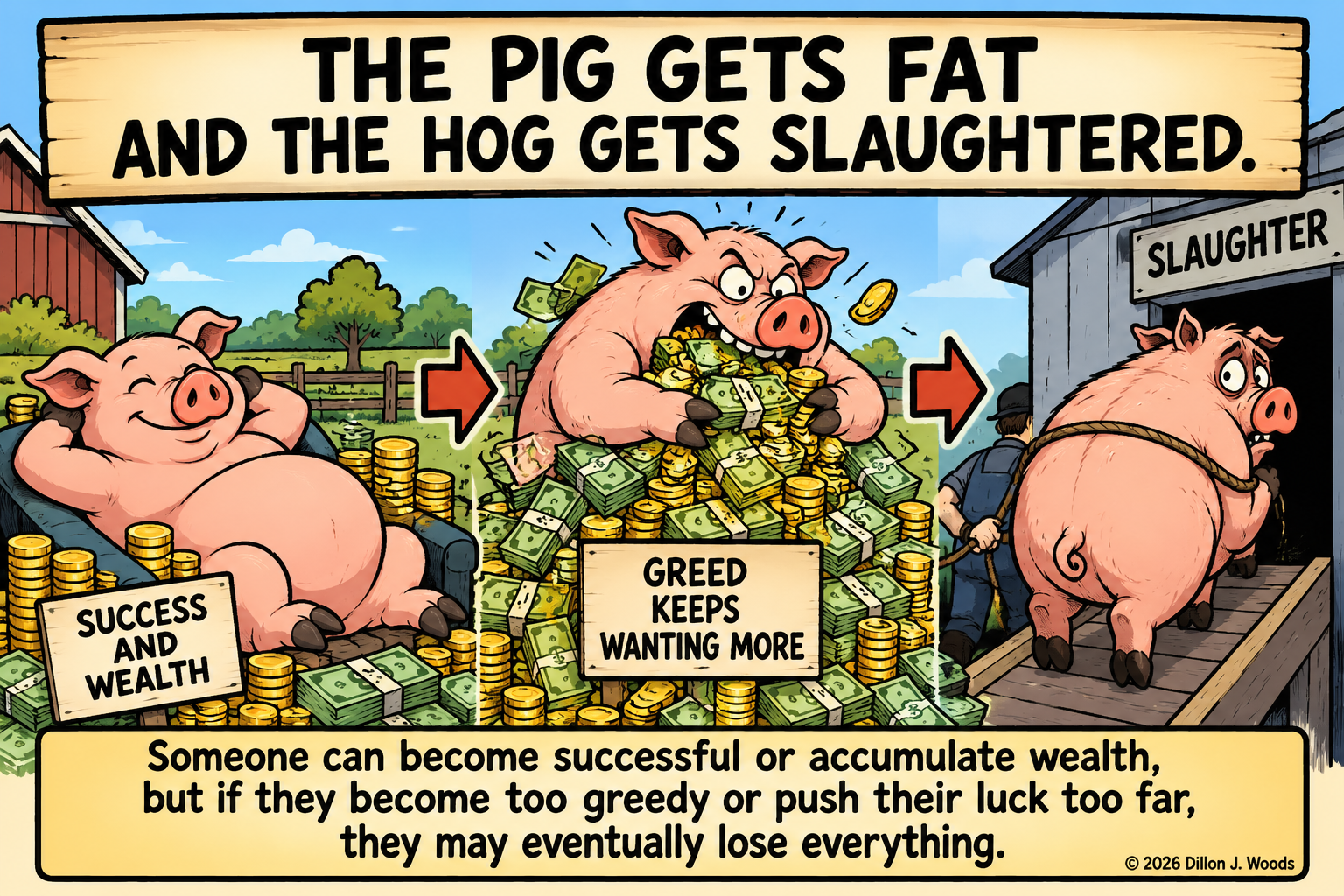
This is why the proverb “the pig gets fat, but the hog gets slaughtered” is such a useful metaphor. The pig represents healthy success and accumulation of wealth; the hog represents the point at which the pursuit of more becomes so dominant that it creates risks capable of destroying the success that was already achieved.
Importantly, this doesn’t mean wealthy people are inherently greedy. Many wealthy people continue accumulating assets for legitimate reasons—business expansion, philanthropy, investment, family security, or preserving an organization. An issue arises when “more” becomes an end in itself rather than a means to a meaningful purpose in life. The same principle can transmit to other human experiences and drives, such as hatred, revenge, power, envy, pride, jealousy, obsession with status, fear, addiction, the need for control, the desire for admiration, resentment, and the desire to dominate others.
A healthy desire serves a person. An unhealthy obsession makes the person serve the desire. Here is how it often comes about: Ordinary desire or emotion → fixation → obsession → loss of perspective → increasingly extreme behavior → self-destruction.
This is what makes greed such an interesting subject and so relevant to the Kathy Checchi, Al Checchi, Adam Checchi, David Kanuth, Michael Fisher, Oprah Winfrey, and other CIA Checchi family cult leaders. Wanting money isn't inherently destructive. Wanting justice isn't inherently destructive. Wanting recognition, power, security, or success is not inherently destructive.
The danger arises when a desire becomes insatiable and begins overriding other important values, commitments, and relationships, ultimately turning a once-healthy desire or goal into a destructive obsession that can consume and ultimately extinguish the very person pursuing it.