October 2026
The Unified Theory of Time, Consciousness, States of Being and Being Human
By Dillon Woods
For many years, I have been thinking about Albert Einstein’s idea that the distinction between the past, present, and future is an illusion, albeit a persistent one. This idea has led me to question how we understand time and whether our everyday perception of it captures the full nature of existence. Is the past, present, and future are more deeply connected than we ordinarily experience them? If so, how might that relationship connect to consciousness, the different states of being awake and asleep, and the physical, mental, psychological, and spiritual dimensions of being human?
Einstein’s statement is often interpreted in the context of relativity and the way physics challenges our intuitive understanding of time – the past, present and future. It does not, by itself, establish that past, present, and future are interchangeable or that the future can be consciously accessed. Is it true that some people can “remember” the future, just as some people can remember the past? In religious circles, these people who seem to know the future are called ‘prophets.’ Is this kind of worldview total nonsense, or is this a valid human experience that is worthy of study, reflection, and investigation?
I once lived next door to a retired woman who had spent a large part of her life studying paranormal activity as a scientist. She claimed that these types of extrasensory experiences, déjà vu experiences, visions and premonitions were common among many people, especially women. For thousands of years humans have documented having these kinds of experiences - from indigenous tribes to prophets documented in the Jewish scriptures and Christian writings.
There are dozens of examples documented in the Bible. For example, in John 1:48 where Jesus says he “saw” Nathanael under the fig tree before Philip called him. The original Greek “εἶδόν σε” translates into “eidon se” which in English means, “I saw you.” “Jesus saw Nathanael coming to him, and said about him, ‘Behold, an Israelite indeed, in whom is no deceit!’ Nathanael said to him, ‘How do you know me?’ Jesus answered him, ‘Before Philip called you, when you were under the fig tree, I saw you.’”
There are many more accounts like this documented in the Bible, especially with the Old Testament prophets. You also find examples in the sacred writings and traditions of many different tribes and religions worldwide. These documentations raise a profound question at the heart of my theory: are these experiences simply coincidences or creations of the human mind, or might they reveal something about the relationship between consciousness, perception, and the nature of time that we have yet to fully understand about the powerful abilities of the human organism?
I’ve heard many people tell me about an experience where they were going about their day when, out of nowhere, they suddenly started thinking about someone. Moments later, their phone rings, and it is the very person they were just thinking about. Is this simply a strange coincidence, or could it be an example of knowing what is about to happen in the future?
Since I was a child, I have been fascinated by the invisible components of the human experience. When I was fifteen, I wanted a subscription to Psychology Today magazine after reading an issue at the library and finding the content fascinating. I grew up in a very religious family, so conversations about spiritual life and the spiritual dimension of human existence were a regular part of my upbringing.
I have personally experienced déjà vu countless times. On a few occasions, I have been convinced in the moment that the feeling of having lived through an experience before was directly connected to a dream I had while sleeping. I remembered the dream and it was exactly being lived out in the present moment. These experiences led me to think more deeply about Einstein’s ideas concerning the relationship between the past, present, and future. I began to wonder whether, during sleep, we might somehow access aspects of the past, present, and future in ways that we do not yet understand.
These ideas and questions raise a profound philosophical question that has stayed with me for decades: What if time is not best understood in isolation, but as one interconnected dimension of a larger system of human existence? Was Einstein correct in suggesting that the distinction between the past, present, and future may be an illusion, and that all three could coexist at some level of reality? I wonder whether our relationship with time is more complex than our ordinary perception suggests. Consider, for example, how people respond when tragedy strikes. They return to the site, leave flowers, or light a candle in remembrance. The event belongs to the past, yet its presence remains powerful in the lives of those who remember it. Why does the past continue to feel so present, and what might this tell us about the relationship between time, consciousness, and the human organism?
Are we, as human beings, living behind a veil or curtain, with blinders that limit our perception of reality to a narrow window of experience, moving in what we perceive as one direction—from the present toward the future? If this is possible, how might we explain the experiences of people who report premonitions or insights that seem to allow them to anticipate future events, almost as though they are “remembering” the future, remembering something that has not yet happened in the present moment?
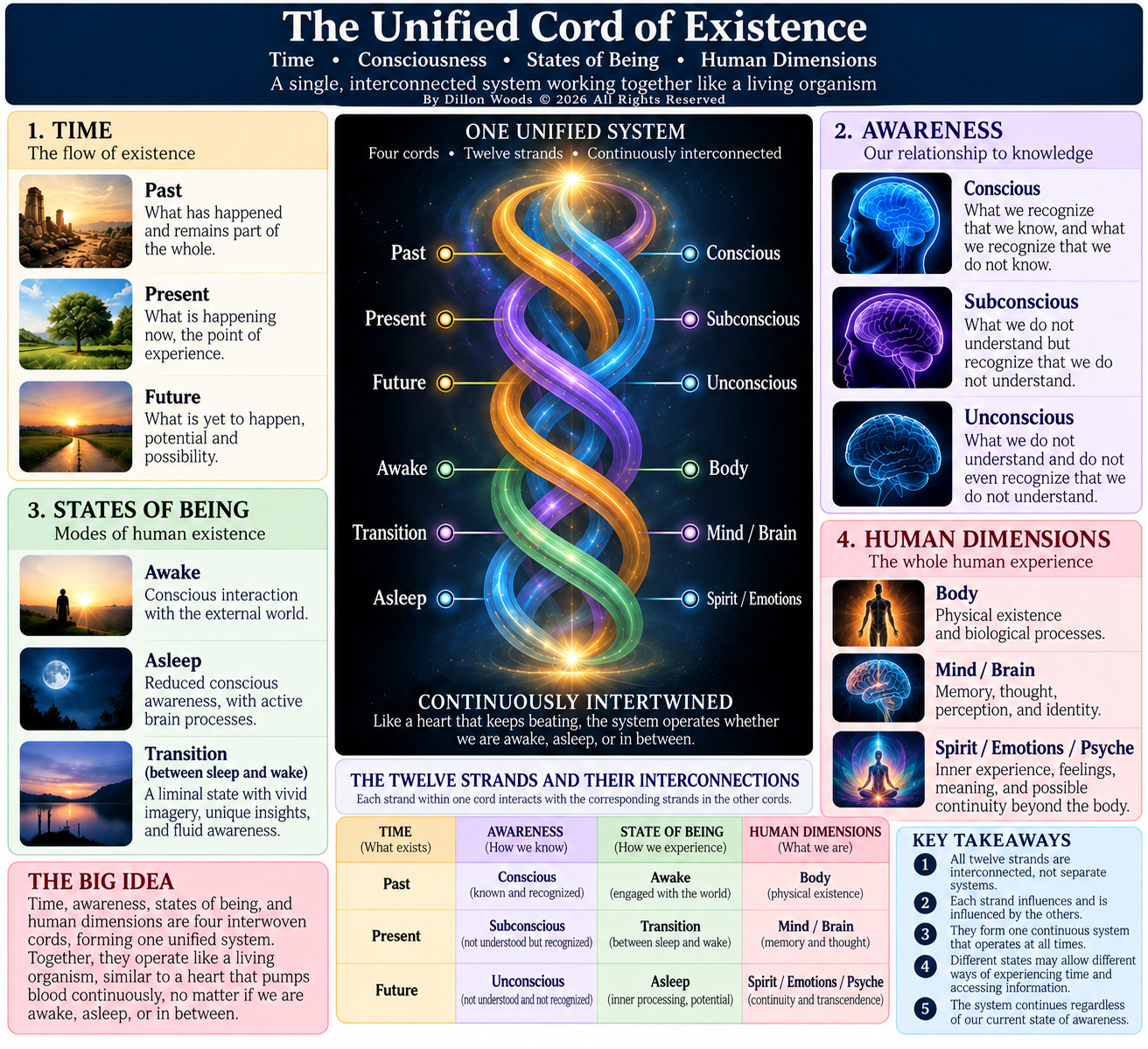
These questions became one of the starting points for my Unified Theory of Time, Consciousness, States of Being and Being Human. As I explored the relationships among past, present, and future, I began connecting them with conscious, subconscious, and unconscious awareness; the states of being awake, asleep, and transitioning between them; and the body, mind or brain, and spirit, emotions, or psyche. These four groups eventually formed the twelve strands represented in my chart, woven together as one unified cord working together as smoothly and consistently as your heart right now pumps blood throughout your body as you read this.
The connection to Einstein’s idea and my own personal experience of being human are therefore the things that inspired my exploration in this area. My contribution is the attempt to bring these four groups together in a single conceptual framework and investigate whether their relationships can help us better understand time, consciousness, and the experience of being human.
For years I have also been thinking about some of the most fundamental questions of human existence: What is time? What is consciousness? What happens when we move between being awake and asleep? How do the body, mind, emotions, and spirit relate to one another? And what if these questions, which are often studied separately, are different parts of one larger system that connects everything about being human?
These questions have stayed with me for many years, leading me to explore the relationships between time, awareness, sleep, thought, memory, physical existence, and the possibility of something beyond what we can directly observe or explain in scientific terms, using the scientific method as we know it in 2026. I have come to believe that understanding any one of these dimensions in isolation may leave us with an incomplete picture. Perhaps the key is not to separate them, but to examine how they interact, overlap, and remain connected throughout our entire existence.
The idea that eventually became the foundation of this paper did not emerge from a single question or a sudden decision to develop a theory. It grew out of years of thinking, questioning, observing, studying, reading, conversing with others, and making connections between ideas that initially appeared unrelated.
Then, one day during a transition into sleep, a new connection seemed to bring many of these questions together within me. The insight came all at one time and with a sense of urgency, as though I needed to capture the idea before it disappeared. I began putting the pieces into words and exploring their relationships through a conversation with ChatGPT, which I have used to write this paper and create the chart below. What began as an attempt to explain an emerging thought gradually evolved into a more organized conceptual framework that I hoped others would find helpful or interesting.
That conversation with ChatGPT helped me examine four interconnected groups of three: 1) past, present, and future; 2) conscious, subconscious, and unconscious awareness; 3) awake, asleep, and the transitional states between them; and 4) the human dimensions of body, mind or brain, and spirit, emotions, or psyche. I’ve found that some scientifically-emersed people are offended at the suggestion that humans have a “spirit” because there is no proof of it. So, I think including in that category emotions or psyche is fair. What I am focused on in that area is the invisible part of the human organism, call it what you will. As these four groups were placed alongside one another, I began to see the possibility of a unified structure. Rather than treating the twelve elements as separate categories, I envisioned them as strands woven together into a single cord of existence, with each strand influencing and relating to the others.
This developing framework became what I call the Unified Theory of Time, Consciousness, States of Being and Being Human. Its central proposition is that time, consciousness, states of being, and the dimensions of human existence may be understood as interconnected aspects of a larger whole. The cord is a visual and conceptual metaphor for this relationship: individual strands retain their distinct characteristics, yet none needs to be understood entirely apart from the others. Together, they form a more comprehensive picture of the human organism.
Within this framework, I began exploring possible relationships between the present and the physical body; the past and the mind’s capacity for memory and reflection; and the future and the mind’s capacity for foresight, imagination, and anticipation, alongside questions surrounding spirit, emotions, psyche, and the continuity of existence. These associations are starting points for investigation, not established scientific conclusions. Some of the questions I explore may fall outside the scope of current scientific methods, particularly when they concern aspects of human experience that are invisible, which cannot be directly observed or measured using existing scientific tools. Their purpose is to raise questions about whether our ordinary ways of dividing experience into separate categories obscure relationships that deserve closer examination.
The importance of this inquiry is that it attempts to connect questions that are frequently addressed by different disciplines. Physics and philosophy examine time and existence. Neuroscience and psychology investigate consciousness, memory, perception, and sleep. Religious and philosophical traditions have long explored the nature of the self, the spirit, and what it means to be alive. Each field offers its own concepts, evidence, and limitations. This paper does not assume that these perspectives already agree, nor does it claim that a single diagram can resolve their differences. Instead, it asks whether a framework that places these dimensions in relationship with one another might provide a useful new way to organize the questions and investigate the connections.
The process of developing this idea has also reinforced an important distinction: an insight can inspire a theory without automatically proving it. However, proving a theory through traditional scientific methods available in 2026 may be difficult, particularly when investigating aspects of the human organism and human experience that cannot be directly observed. There is no doubt that some aspects of human experience are invisible to the naked eye. For example, a thought is invisible. If we wanted to investigate the physical structure of a finger, we could examine it and identify its components, including blood vessels, bone, and layers of skin. But how would we investigate the nature of a thought? We cannot simply cut into the brain and see a thought in the same way we can examine the physical components of a finger. Although modern science can study brain activity associated with thinking, the subjective experience of having a thought presents a different challenge. How do we fully explain something we experience directly but cannot observe as a physical object in the same way we observe other parts of the human organism?
The experience of discovering a connection may be deeply meaningful, but the framework itself must be evaluated through careful reasoning, comparison with existing scholarship, clear definitions, and, wherever possible, evidence that could support or challenge its claims. For that reason, this paper presents the Unified Theory as a developing conceptual model. It seeks to distinguish philosophical interpretation from established knowledge and to identify which parts of the framework may be explored scientifically and which parts may not be explored using scientific methods available to us in 2026. In the future, humans may come up with new ways to investigate such issues that limit our ability to investigate today.
Ultimately, this paper is an attempt to look at human existence from a wider perspective. Instead of asking only how time works, how consciousness arises, why we sleep, or what makes us human, it asks a broader question: What if these are not entirely separate mysteries, but interconnected parts of one unified system? The Unified Theory of Time, Consciousness, States of Being and Being Human begins with that question. Its purpose is to explore the connections, explain the proposed structure, compare it with ideas that have come before, and invite further examination of what it may reveal about the experience of being alive.
The Theory: How Twelve Strands Become One Unified System of Existence
The foundation of my theory is the idea that time, consciousness, states of being, and the different dimensions of human existence should not be viewed as isolated subjects. Instead, I propose that they can be organized into one interconnected system in which each dimension has its own characteristics while remaining connected to the others. The theory developed as I began recognizing patterns between concepts I had been thinking about for years and my own experience of being human. What initially appeared to be four different subjects gradually became a framework of four groups, each containing three elements, with twelve elements in total. I came to visualize these twelve elements as individual strands woven together to form one unified cord of existence within a human being.
The key to understanding the theory is that I did not begin by deciding to create twelve strands. The structure emerged as I explored the relationships between the questions that had occupied my thoughts for many years. I was trying to understand time, the different levels of awareness, the transitions between sleeping and waking, and the relationship between the body, mind, and spirit/psyche. As I considered these subjects together, I began to see that each could be divided into three related components. When I placed the four groups alongside one another, the possibility of a unified structure became apparent.
The resulting chart is intended to represent more than a collection of definitions. It illustrates a way of thinking about existence in which the individual components retain their identities but are understood in relation to the larger system. The cord represents their interconnection, while the individual strands represent the distinct dimensions that contribute to the whole. The central idea is that the system cannot be fully understood merely by examining its components separately; we must also investigate how they relate to, influence, and potentially depend upon one another.
1. THE FIRST GROUP: TIME
The first group consists of the past, present, and future. These three dimensions provide the temporal framework through which human beings understand their existence.
The past represents what has already occurred. In human experience, it is connected to memory, accumulated knowledge, previous experiences, and the events that shape how we understand ourselves and the world in which we live. Although past events cannot ordinarily be changed, our understanding of them can change as we acquire new information or interpret our experiences differently.
The present represents the immediate experience of existence: what is happening now. It is the point at which we perceive our surroundings, experience our bodies, make decisions, and act upon the world. The present is also the point from which we remember the past and anticipate the future.
The future represents what has not yet occurred from our present perspective. It includes possibilities, expectations, plans, uncertainties, and the consequences that may follow from present actions. We imagine the future using information drawn from memory, observation, reasoning, and our emotions.
In the unified framework, past, present, and future are distinct but connected. Memories of past experiences can influence present decisions, present actions affect future possibilities, and expectations about the future can influence how we behave, live and feel in the present moment. This creates a continuous relationship between the three temporal dimensions in human experience. Why most humans can remember the past but not “remember” the future is a question worth considering. Is it possible to have experiences of “remembering” the future?
My theory asks us to consider how these relationships interact with the other nine strands. How does our experience of time relate to consciousness? Does the way we experience time change when we are asleep? How do memory, physical sensation, and emotion influence our perception of past, present, and future? These questions begin to connect time to the rest of the system.
This framework does not assume that the past, present, and future are physically identical or that the future can be known in advance. Rather, it uses their relationships in human experience as a starting point for examining the broader connections among time, awareness, and existence.
2. THE SECOND GROUP: CONSCIOUSNESS AND AWARENESS
The second group consists of the conscious, subconscious, and unconscious. These terms represent different aspects of awareness within my conceptual framework. My initial working definitions were based on the distinction between what we understand, what we recognize that we do not understand, and what we may not even realize we do not understand.
The conscious dimension represents what we are aware of at a given moment. It includes thoughts we can recognize, sensations we can attend to, decisions we are actively making, and questions we know we have not yet answered. Conscious awareness allows us to reflect on our experiences and examine our own thinking.
The subconscious dimension represents information, processes, or questions that are not fully understood or actively present in awareness but that we recognize as incomplete or not fully understood. In developing the theory, I used this category to describe the space between what we consciously understand and what remains outside our immediate awareness. The term subconscious is used differently across psychological traditions, so this definition is a working definition for the theory rather than a universal clinical definition.
The unconscious dimension represents what remains outside our awareness, including processes or influences we may not recognize at all. In psychological research, unconscious processing can include mental operations that occur without conscious awareness. My broader conceptual use also raises a philosophical question: how can we investigate the limits of our knowledge when we may not know what we are missing? It’s like trying to finish a puzzle without realizing that you are missing pieces of that puzzle.
These three dimensions connect to time because awareness is not confined to the immediate moment. We consciously recall the past, interpret present experiences, and anticipate the future. Processes outside our awareness can also influence our judgments, reactions, and expectations. Sleep and transitions into or out of sleep may alter what we notice, remember, or experience.
The connection is therefore reciprocal at the conceptual level: our awareness shapes how we experience time, while our experiences across time contribute to what we know, remember, anticipate, and fail to recognize.
3. THE THIRD GROUP: STATES OF BEING
The third group consists of being awake, being asleep, and the transition between the two. I included this group because the human experience is not limited to one stable state of awareness. We move through different states every day, and those transitions raise important questions about consciousness and the continuity of experience.
Awake represents the state in which we ordinarily interact with our surroundings, process information, communicate, and consciously respond to events. During wakefulness, sensory information, memory, attention, and thought contribute to our understanding of the present.
Transition represents the process of moving between waking and sleeping. These transitions can include what sleep professionals call “hypnagogic” experiences as a person falls asleep and “hypnopompic” experiences as a person wakes. During these periods, people may experience vivid imagery, unusual associations, fragments of thought, or sudden insights. The boundaries between sleep and wakefulness are not always experienced as an instantaneous switch.
Asleep represents the range of states associated with sleep. Sleep is not a single uniform condition: it includes different stages with distinct patterns of brain activity, responsiveness, and memory processing. Dreams may occur during sleep, and people may sometimes recall experiences that seem vivid or meaningful after waking.
This group became especially important to the development of my theory because the idea that inspired the framework came to me while I was falling asleep. I had been thinking about related questions for years, and during that particular sleep transition that day, a new way of connecting them emerged instantaneously. I wanted to capture the idea immediately and examine it before the details faded, so while I continued to be half asleep, I turned to ChatGPT for a conversation on this topic.
That experience did not prove that the insight came from an external source or that it revealed a hidden law of the universe. However, it provided a personal example of why transitions between states of being deserve attention. A person can spend years considering a subject and then suddenly recognize a connection that had not previously been apparent.
Within the unified framework, the states of being connect with all the other groups. Our experience of time can change during sleep and dreams. Conscious awareness changes as we fall asleep and wake up. The body continues its essential biological functions throughout these transitions, while brain activity and subjective experience change. These relationships offer a concrete starting point for examining how several strands operate together.
4. THE FOURTH GROUP: THE DIMENSIONS OF BEING HUMAN
The fourth group consists of the body, mind or brain, and spirit, emotions, or psyche. I included this group because time, awareness, and sleep are experienced and interpreted through the human condition. The theory would be incomplete without considering the dimensions through which we experience our existence.
The body represents our physical existence. Through the body, we receive sensory information, move through the world, experience physical needs, and interact with our environment. The body changes over time, carries the effects of past experiences, and participates in the actions through which we influence the future. It continues performing essential functions during both waking and sleeping states, even when conscious awareness is reduced.
The mind or brain represents the processes associated with perception, thought, memory, reasoning, imagination, and many aspects of consciousness. The brain is a physical organ, while the mind refers to mental processes and experiences associated with brain activity and, in broader philosophical discussions, questions about the nature of thought and subjective experience. In my framework, this dimension has a particularly strong conceptual relationship with the past because memory and prior experience help shape present understanding. However, the mind is not limited to the past: it also interprets the present and imagines the future.
The spirit, emotions, or psyche represents the dimension through which I want to explore feelings, personal meaning, identity, inner experience, and questions about the nature or continuity of the self. I have associated this dimension with the future because it raises questions about possibility, purpose, what we become, and what—if anything—continues beyond bodily life. This association is a philosophical proposal, not an established scientific finding. Spirit, emotion, and psyche are not interchangeable concepts in every discipline or tradition, and further development of the theory will require defining their relationships more precisely. As I mentioned previously, for the purposes of this paper I’m looking at the invisible aspects of the human organism.
These three dimensions are closely connected in ordinary human experience. Physical conditions can influence mood and thinking. Emotions can affect attention, decisions, and bodily responses. Memories influence how we interpret sensations and relationships. Thoughts and intentions can lead to physical actions, which in turn create new experiences and memories.
The theory proposes that these dimensions should be considered together without assuming that they are identical or that all their relationships are already understood. The body, mind, and emotional or spiritual dimensions each raise different questions, but all contribute to the broader question of what it means to be human.
5. WHY I ASSOCIATED THE BODY WITH THE PRESENT, THE MIND WITH THE PAST, AND SPIRIT WITH THE FUTURE
One of the more distinctive parts of my developing framework is the relationship I proposed between the human dimensions and the three dimensions of time. I associated the body with the present, the mind or brain with the past, and spirit, emotions, or psyche with the future.
I made these associations because they offered a way to explore how our physical, mental, and inner experiences relate to time and consciousness. The body is experienced in the present: we feel its sensations, respond to its needs, and act through it in the world. The mind carries memories of the past and uses those memories to interpret current circumstances. The emotional, psychological, and spiritual dimensions can orient us toward the future through hope, fear, purpose, imagination, creativity, and questions about what the future holds for us.
However, these relationships are not exclusive. The body contains the effects of past events and changes as time passes. For example, if you have a history of eating a lot of ice cream, your present body may reflect that history through increased body fat. The mind operates in the present and has the ability to make plans for the future. Emotions can arise from memories, respond to present circumstances, or anticipate future events. The point of the associations is not to confine each human dimension to one period of time, but to identify a useful conceptual relationship that can be explored further.
I also considered philosophical and religious ideas concerning the spirit and the possibility of existence beyond physical life. Some traditions propose forms of continuity beyond bodily death, while scientific accounts of human consciousness investigate the relationship between conscious experience and brain function. These perspectives do not establish the same conclusions, and my theory does not claim to resolve that disagreement. Instead, the proposed connection between spirit and future identifies an important question for philosophical inquiry: how do human beings understand continuity, mortality, identity, and the possibilities they imagine beyond the present?
The associations are therefore intended as an organizing hypothesis. Their value depends on whether they help clarify relationships, generate useful questions, and withstand careful examination.
6. THE CHART: TWELVE STRANDS WOVEN INTO ONE CORD
The chart brings the four groups together visually. Each group contains three elements, creating twelve strands in total. The four groups are time, consciousness and awareness, states of being, and the dimensions of being human.
The cord is the central image because I wanted to represent a system in which the individual elements are connected rather than isolated. A woven cord consists of distinguishable strands, but its overall structure depends on how those strands are arranged and intertwined. In the same way, the chart presents the twelve elements as distinct concepts that can be examined individually while also being considered in relation to the larger framework.
The four groups provide different ways of approaching existence. Time provides the temporal dimension. Consciousness provides the dimension of awareness. States of being provide the dimension of changing conditions of wakefulness and sleep. The human dimensions provide the physical, mental, emotional, psychological, and philosophical aspects of the person experiencing existence.
The chart does not mean that each strand is a separate physical force or that a scientific mechanism connecting all twelve elements has already been demonstrated. It is a conceptual map. Its purpose is to make the proposed relationships visible and to encourage the reader to consider connections that might be overlooked when the subjects are studied separately.
The symmetry of the four groups is important to the visual idea. No group is intended to stand alone as the entire explanation of existence. Each contributes a different perspective. The theory becomes unified when the groups are considered together and the possible relationships among their individual elements become the focus of inquiry.
7. HOW THE TWELVE STRANDS INTERACT
The central proposition of the theory is that the twelve elements can be examined as an interconnected system. This does not require claiming that every element directly causes every other element. Rather, the framework invites us to identify the relationships that can be supported by observation, established knowledge, philosophical reasoning, or future research.
Consider the relationship between the past, the mind, and consciousness. A past experience may be stored in memory, recalled consciously, and used to influence a present decision. That decision may lead to an action performed by the body. The action creates a new experience, which may later become part of memory. The sequence links time, awareness, and the human dimensions in a continuous process.
Now consider the relationship between sleep and the same elements. As a person falls asleep, the state of being changes. Conscious awareness may become less stable, while unusual imagery or associations sometimes arise. The brain continues to function, the body continues its biological processes, and the person's experience of time may differ from ordinary waking experience. Upon waking, the person may recall a dream or an insight, interpret it using prior knowledge, and decide what to do next. Again, several strands participate in one experience.
Emotions provide another example. A memory of a past event may produce a present emotional response. That response may affect the body, influence conscious thought, and shape expectations about the future. Those expectations may then influence behavior. This illustrates how temporal experience, awareness, emotional life, and physical action can be understood as interacting dimensions rather than unrelated topics.
These examples help explain what I mean by a unified system. The strands do not need to become identical to be connected. They remain different, but their relationships contribute to the way human experience unfolds.
8. Why I Call It a Unified Theory of Existence
I call the framework a unified theory because its central purpose is to examine the relationships among different dimensions of existence. The word unified does not mean that everything is interchangeable, that all mysteries have been solved, or that the universe has been proven to operate according to this exact twelve-strand structure. It means that the theory begins with the possibility that apparently separate aspects of experience can be understood more fully when considered together.
The heart pumping blood provides a useful analogy. A heartbeat continues pumping blood through waking and sleeping, even though our awareness and experiences change. This illustrates how one underlying biological process can persist while our state of being varies. The analogy is not proof that all twelve strands share a single mechanism; it helps communicate the broader idea that continuity and change can coexist.
Similarly, human existence includes both stable processes and changing experiences. The body undergoes continuous biological activity. The mind processes information and forms memories. Conscious awareness changes in intensity and content. Sleep alternates with wakefulness. Our understanding of the past influences present behavior, while our actions help shape future circumstances. These processes are not all the same, but they participate in the wider continuity of human life.
The theory extends this perspective by asking whether a similar organizing approach can help us investigate the relationships between time, consciousness, states of being, and the dimensions of being human. It proposes that the connections deserve attention alongside the individual components.
9. THE IMPORTANCE OF EXAMINING THE THEORY
The importance of this framework is not simply that it organizes twelve ideas into a chart. Its potential value lies in the questions it raises. Can we better understand human experience by examining time, awareness, sleep, and the dimensions of the self within one conceptual structure? Which relationships are already supported by scientific research? Which are philosophical interpretations? Which remain speculative? Can the framework generate clear questions that existing models do not address as directly?
These questions matter because understanding human existence requires both curiosity and discipline. A compelling connection can be a starting point for inquiry, but it must not be confused with proof required by present day scientific models. The framework should be compared with existing work in neuroscience, psychology, philosophy of mind, sleep research, physics, and religious philosophy. Its concepts should be defined clearly, and its claims should be revised if evidence shows that a proposed relationship is inaccurate or unhelpful.
The theory may ultimately prove most useful as a philosophical framework for organizing questions rather than as a single scientific theory that explains every dimension of existence. Alternatively, further work may reveal particular relationships that can be developed into more precise, testable hypotheses. Either outcome would contribute to clarifying what the framework can and cannot explain.
CONCLUSION: ONE CORD, TWELVE STRANDS
The Unified Theory of Time, Consciousness, States of Being and Being Human emerged from years of questioning and an attempt to recognize relationships among subjects that are often considered separately. Through reflection, study, and conversation, I began organizing those subjects into four groups of three: past, present, and future; conscious, subconscious, and unconscious; awake, transition, and asleep; and body, mind or brain, and spirit, emotions, or psyche.
The twelve elements form the structure of the chart, while the woven cord represents the central idea connecting them. Each strand has its own meaning, yet the framework asks us to examine how the strands may interact within the broader experience of existence. The past influences the present, the present shapes future possibilities, awareness changes across states of being, and the body, mind, and emotional or spiritual dimensions contribute to how we experience, understand, and interpret the world in which we live.
My intention is to offer a framework for inquiry, not to claim that every relationship has been proven or that one theory can answer every question about existence. The starting point is a simple but far-reaching possibility: perhaps we can understand more about what it means to be human by looking beyond isolated categories and investigating the relationships that connect them all into one consistent cord of being. The unified cord is a representation of that possibility. Its twelve strands are the beginning of the inquiry, not the end of it.
Thank you for taking your time to read this essay. I hope you found this topic interesting and helpful in your own journey to understand what it means to be human.
Dillon Woods
Independent Journalist
* My writing is often edited and improved using ChatGPT.
My books are at this link and your support is appreciated: www.amazon.com/author/dillonwoods.